Chicken Jerky: The Yolk’s On You!
original post:
http://www.dogsnaturallymagazine.com/chicken-jerky-the-yolks-on-you/

I love my dogs and want them to live forever; doesn’t everyone?
We have a lot in common. If you’re reading these words, I probably
don’t need to get into historical details about my dogs. You don’t need
specifics about our friendship and how they changed my life for the
better because you probably already know. I struggle not to share my own
experience and the health implications that chicken jerky treats had on
my dogs. Let’s talk truth and leave personal pain and bias out of this.
This won’t be your typical article about chicken jerky. I don’t want
to overwhelm you with controversial medical claims, lawsuits, and
statistics. But now that many of the suspected products have been
recalled, I don’t want you to think that your dogs are necessarily safe
either.
As the dust is settling on the chicken jerky debacle, it might be
time to reflect back on the facts and some critical thinking. Let’s
allow our minds to formulate some questions that few have pondered.
Questions we need to start asking ourselves as responsible pet owners.
Questions that may lead to informed answers and a healthier existence
for our furry companions.
I meet a lot of pet owners in my work. I own a pet food shop and star
in a TV series documenting pet obesity. It became pretty clear to me
that a lot of people seemed to be feeding their pets chicken strips with
the misguided perception that they were good old fashioned North
American meat products. The colorful bags with pictures of all natural
chicken breast were a great value and the affordable price made it
impossible to turn down. What could possibly be more natural and healthy
than chicken breast strips?
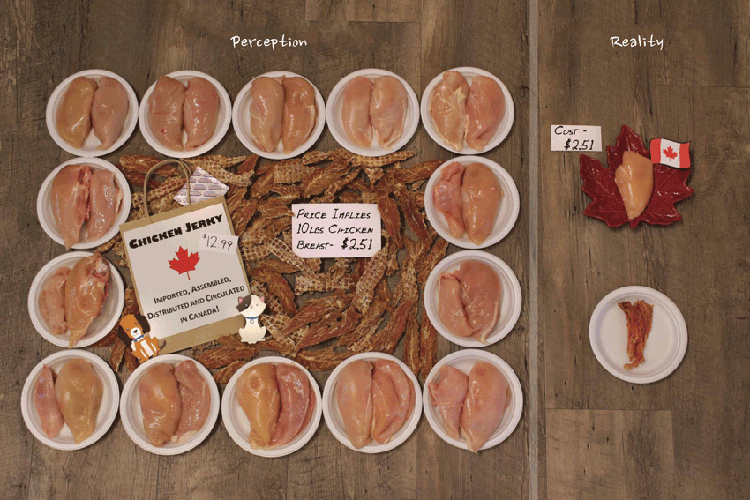
Allow me to try and answer this question with an illustration and some questions of my own….
Cue the observation of the photo, please:

Some of these chicken jerky bags have US or Canadian symbols all over
them, so they must be made here in North America, right? Flip around to
the back of the bag and then take a stab at the daunting task of finding
where the meat actually comes from. You might see “imported by” or
“distributed by” in large print but where is the “made in”? Well,
sometimes it isn’t there; other times it’s in super tiny print.
Imagine for a moment that there was no labeling at all, just a plain
bag of perceived Canadian or American “natural” jerky treats with the
weight and the price. For example, we see large bags in stores today for
around $12.99 and the weight of the bag is a monstrous 2.5 pounds. What
a deal!
As a boy who was born and raised in Canada, it sounds about right
mathematically since it costs, on average, $6.49 for a pound of standard
Canadian chicken breast. The prime or natural chicken is about $8.00
per pound and hormone free Canadian chicken from the farmers market is
$12.49 per pound.
But wait a second! This is dehydrated chicken we’re talking about.
According to the USDA Food Safety and Inspections Services, and my
biology teacher, poultry is composed of approximately 75% water.
So, on average, that means approximately ten pounds of hydrated
“natural” chicken is needed to make that $12.99 bag of dehydrated jerky
treats. So, at $12.99 for ten pounds of Canadian chicken breast… we’re
$1.29 a pound? That seems like a far cry from the amount you would pay
at the supermarket for fresh Canadian chicken breast, doesn’t it? At
retail cost, that bag should be worth almost $80 (and I know this
because that’s what it cost me for all that chicken in the photo)!
Now what about the box store that sold you these jerky treats? They
buy them from the distributor at a lower price and then mark up the cost
of the bag of jerky to help pay for their expenditures, and rightfully
so. The average industry standards for profit on treats in box stores or
pet stores is anywhere from 35% to 75%, so let’s just say the markup is
50%. Once we allow for that, the cost of the bag of jerky treats is
around $6.49 for ten pounds of chicken, or 63 cents for a pound of
Canadian chicken.
Hold on, there’s more!
Who could believe anyone could pay 63 cents retail for a pound of
sliced Canadian chicken breast? That sounds absurd, doesn’t it? But hang
on we’re not done yet. The manufacturer, the company that sold the
dehydrated meat to the big box store in the first place, needs to make a
profit! Since I’m not a chicken jerky manufacturer, an estimate needs
to be made here, but I think 60% would be a fair mark up (taking into
consideration the cost of the shiny bag, labor, shipping, remaining
expenses and finally a decent profit). So now that bag of treats, that
some believe could be pure, natural, Canadian chicken breast, is valued
at around $2.51 for ten pounds of hydrated chicken. That’s 25 cents per
POUND OF CANADIAN CHICKEN BREAST!!??
What?
Even if I’m off a bit on my estimated amount for the manufacturer’s
markup, doesn’t chicken breast at under 50 cents per pound seem too good
to be true? Anybody?
When we look at that bag of chicken jerky, we think it’s good value;
but the price tag reveals the actual cost of the meat and this should
hopefully make you take a harder look at the value of that bag of jerky.
The moral of the story is that if it sounds too good to be true, it
usually is!
Simply stated, you get what you pay for: 4D meat sourcing (Diseased,
Disabled, Dying or Dead). Farmers basically give this “meat” away or
actually pay to have those chickens removed from their farms.
I thought that you should see what the real value is in $2.51 worth
of Canadian chicken so I bought and dehydrated the chicken on the left.
As you can plainly see, the end result offers a much smaller amount of
chicken than the store bought chicken jerky.
Perhaps I’ll conclude with a fitting quote. A wise man once said:
“The reason that we will succeed today while others have failed
yesterday, is purely because of the attention to detail.”