Tuesday, April 2, 2013

Rawhide: The Good, The Bad, and The Ugly

Rawhide: The Good, The Bad, and The Ugly

        Become A          Dogington Post    Member And Receive Email News And Tips.  Name: Email: We respect your email privacy 

There are countless types of dog chews, bones, and toys in the market today, and rawhide is one of the most popular. Because there have been lots of concerns regarding the safety of rawhide dog chews, it is a good idea to be familiar with the various kinds of rawhide available as well as the pros and cons accompanying these types of chew toys. With the necessary facts, you can make a sound decision about whether or not to allow your pooch to chow down on the popular knotted chew bone.

The Good:
· It promotes healthy gums and teeth in dogs. As the rawhide chews get moistened, it tends to wrap around your pooch’s teeth; rubbing off any plaque buildup which in turn reduce his risk of acquiring serious dental problems.

· It prevents dogs from chewing valuable items at home. Because rawhide chews can keep your pooch busy for several hours, you can keep your clothing, furniture, and other belongings from being chewed on.

· It relieves teething pain that most puppies struggle with. When puppies start gnawing on rawhide chews, they tend to feel less pain as their teeth push through. Besides, rawhides help them in developing strong jaws.

· Your dog will likely love them. A lot of pet owners ignore the downsides to rawhide treats when the see the pure joy of a dog with a fresh, new chew. While there are some Pros to rawhide treats, careful selection and proper use are still vitally important.

The Bad:
· It can be a choking a hazard. Once your dog swallows a tiny, broken piece of rawhide, that portion can get lodged in his throat; putting him in serious danger. To avoid this, immediately take the rawhide away as soon as it becomes small enough to be swallowed whole.

· It can cause digestive blockage. Allowing your pooch to swallow a large piece of rawhide can also endanger his life. Rawhides can expand inside Fido’s stomach, putting him at risk of a fatal blockage. It can even wrap around his intestines, causing the same obstruction.

· It can cause gastrointestinal problems. If your pooch ingests too many rawhides, he may develop gastrointestinal complications.

· Not all rawhides are safe to eat. Several reports have revealed that rawhides which have been produced outside USA were made from toxic chemicals. Try to be selective when it comes to buying rawhide. Look very closely where it was manufactured and only choose rawhides made in the USA.

The Ugly:
· Some rawhides contain deadly poisons. The process of making rawhide involves chemically separating the outer layer of skin (usually of a cow) from the hide. This process leaves deadly poisons in the chew, including arsenic and formaldehyde.

· Some rawhides contain the skin from dogs. An investigation by Humane Society International stated in their report, “In a particularly grisly twist, the skins of brutally slaughtered dogs in Thailand are mixed with other bits of skin to produce rawhide chew toys for pet dogs. Manufacturers told investigators that these chew toys are regularly exported to and sold in U.S. stores.”
Ultimately, the choice is yours. But, remember, you’re choosing for your dog. It’s likely that if he could educate himself on what he was eating, he’d choose a safer, healthier alternative.

April is Pet First Aid Awareness Month. Do you know what to do in an emergency?

How to Care for a Bleeding Pet
Working in the ER, I often see dogs suffering from blood loss as a result of trauma, which can become life-threatening if not properly treated. If bleeding is severe or continuous, a dog can lose enough blood to cause shock.

Shock from blood loss is classified as hypovolemic shock, which basically means that there is not enough fluid (blood) circulating throughout the body. Without an adequate volume, organs such as the kidneys and GI tract are not being perfused (nourished), and this state can quickly turn deadly. Your veterinarian can tell if your dog is in shock by physical exam findings such as a high heart rate, a low blood pressure and weak pulses.

Did you know the loss of as little as 2 teaspoons of blood per pound of body weight can result in shock? This blog post describes ways to control bleeding in your pet during transport to your nearest veterinary hospital.

The following techniques are listed in order of preference. As a word of caution: The first rule when dealing with an injured pet is to avoid injury to yourself. Take appropriate precautions, such as the use of a muzzle, to avoid being bitten. You can create a “make-shift muzzle” by using a long piece of material such as a men’s tie, non-retractable leash or piece of cloth. All too often, I see owners having to make a trip to the emergency room for themselves as well as their pet.

The best way to learn these techniques is in a pet first aid class. April is Pet First Aid Awareness Month, a perfect opportunity to sign up for pet first aid classes, which are offered by local chapters of the American Red Cross, some shelters and humane organizations. Also, it's a good reminder to have a complete pet first aid kit (which includes a muzzle) among your dog supplies.

Direct pressure
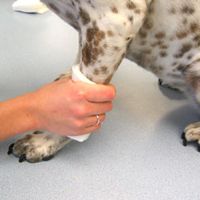
Direct pressure on a wound is the most preferable way to stop bleeding. Gently press a pad of clean cloth, gauze or even a feminine sanitary napkin over the bleeding area: this will absorb the blood and allow a clot to form.

If blood soaks through, do not remove the pad. This will disrupt the clot; simply add additional layers of cloth and continue the direct pressure more evenly. The compress can be bound in place using loosely applied bandage material, which frees your hands for other emergency actions. If you don’t have a compress, you can apply pressure with a bare hand or finger.

Elevation
If a severely bleeding wound is on the foot or leg, and there is no evidence of a broken bone, gently elevate the leg so that the wound is above the level of the heart. Direct pressure of the wound must be continued in addition to elevation.

Elevation uses the force of gravity to help reduce blood pressure in the injured area, slowing the bleeding. Elevation is most effective in larger animals with longer limbs because of the greater distance from the wound to the heart.

Applying pressure on the supplying artery
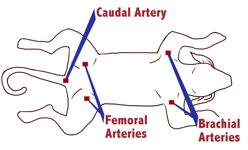
If external bleeding continues after you have used direct pressure and elevation, you can use your finger or thumb to place pressure over the main artery to the wound. For example, if you have severe bleeding on a rear leg, you would apply pressure to the femoral artery, which is located in the groin (on the inside of the thigh). If you have severe bleeding of a front leg, you would apply pressure to the brachial artery, which is in the inside part of the upper front leg.

Tourniquet
Use of a tourniquet is potentially dangerous and should only be used for life-threatening hemorrhage in a limb. If you see blood spurting or pumping from a wound, which, luckily, is a rare occurrence, consider the use of a tourniquet.

Use a 2-inch wide piece of cloth or leash, and wrap it around the limb twice and tie it into a knot. Then tie a short stick or similar object into the knot as well. Twist the stick to tighten the tourniquet until the bleeding stops. Secure the stick in place with another piece of cloth and write down the time it was applied. Every 20 minutes loosen the tourniquet for 15 to 20 seconds. This is potentially dangerous and can result in the need to amputate the limb.  Remember, a tourniquet should only be used as a last-resort, life-saving measure.

Internal bleeding
Internal bleeding is another form of potentially life-threatening blood loss, where blood pools in the abdominal or chest cavity, but does not result in visible blood in the stool or bleeding from the rectum. A few causes of internal bleeding include rat bait poisoning, ruptured masses on the spleen, trauma and sometimes in the case of immune-mediated disease.
Internal bleeding can often be more dangerous because it occurs inside the body, and being less obvious, delays evaluation by your veterinarian. There are, however, some external signs of internal bleeding, which can include any of the following:
  • Your pet’s gums appear pale to white.
  • Your pet feels cool on the legs, ears or tail.
  • Your pet is coughing up blood or having difficulty breathing.
  • Your pet is unusually subdued; progressive weakness and sudden collapse may be observed.
  • Your pet has a painful belly when it is touched.
If your pet is bleeding externally, or you suspect any internal bleeding, immediately transport your pet to your veterinarian or to your closest emergency hospital for treatment.  I hope you never have to use the information in the blog, but I feel it is important for everyone with a pet to know.

Monday, April 1, 2013

Basic Manners Class at Wuf Pet Resort & Spa (4-week class)

Basic Manners Class at Wuf Pet Resort & Spa (4-week class)

Date/Time
Date(s) - Sunday, April 7, 2013
1:00 PM - 3:30 PM
Basic Manners Class: Four (4) Weeks, 1-hour Session each meeting
To reserve: Call (972) 785-2983
What you need: A friendly, hungry dog and lots of small, chewy, high-value treats
Class Objectives: Sit, Stay, Down, Wait, Loose-leash walking, Leave it, Come when called
Dates: April 7, 14, 21, 28 (Sundays)
Class #1: 1:00 pm – 2:00 pm
Class #2: 2:30 pm – 3:30 pm
Limit: 5 dogs per class
Fee: $100.00
For more information, visit https://www.facebook.com/events/140473969457542/ or contact event organizers at wufatus@wufspa.com or (972) 785-2983.


logo_color_jpg

ABOUT THE CLASS
Dogs are social creatures; however, most dogs are placed in a human world on human terms. We, therefore, are responsible for their canine health and mental well-being. In order to accomplish this, all prospective clients should consider the following:

A. Your dog needs to live inside the home with you.

B. Learning takes time! You will need to practice the new behaviors you are learning and teaching your dog. Ask yourself, “How successful do I want us to be?”

C. Each member of the family needs should be encouraged to take part in the training. We want our dog to recognize that humans provide leadership, guidance, and are the source of all things good and wonderful.

During the training process you will develop a keener awareness of your dog, what effects his world, and why. Aversive training techniques using pain, fear, or intimidation will not be used or taught.
ABOUT THE TRAINER – Melissa Knox, CPDT-KA, CPTI

Melissa has been working with dogs for over fifteen years and in 2007, she established Pets & Their People Dog Training, LLC. Melissa and her dogs have dabbled in many dog sports and activities such as competitive obedience, agility, flyball, rally, and tracking. Melissa’s methods of training are based on developing an understanding of the dog’s behavior and then building on the relationship between human and canine in order to create a trusting and committed partnership.

ABOUT THE LOCATION
Wuf Pet Resort & Spa is a luxury dog boarding, daycare and grooming facility right in the heart of the D/FW Metroplex. We’re located off 114/John Carpenter Freeway, just east off the old Texas Stadium site.

For more information, give us a call at 972-785-2983.

7th Annual Dog Bowl at The Cotton Bowl Sunday, April 7, 2013 1:00 PM - 5:00 PM

7th Annual Dog Bowl at The Cotton Bowl

Date/Time
Date(s) - Sunday, April 7, 2013
1:00 PM - 5:00 PM Friends of Fair Park presents the seventh annual
DOG BOWL AT THE COTTON BOWL
Free unleashed fun for dog lovers and pooches of all sizes when historic Cotton Bowl field transforms into a tail-wagging time complete with splash pools, a pet/owner look-alike contest and more
Sunday, April 7, 2013   1 – 5 p.m.
Cotton Bowl Stadium at Fair Park
3750 Cotton Bowl Circle, Dallas, TX 75210

FREE AND OPEN TO THE PUBLIC
Flaunt your four-legged fur ball at Fair Park’s Cotton Bowl Stadium for the free, seventh-annual Dog Bowl from 1 – 5 p.m. Sunday, April 7, when Dallas’ most historic football field transforms into a super-fun dog park for canines of all sizes to romp and run unleashed!

Enjoy pooch-pleasing pastimes including a pet/owner look-alike contest, giveaways, exhibits, pooch portraits, canine crafts, music by Dallas’ seasoned jazz bassist Barri Pearson, and more. (Please note: A nominal fee applies for pooch portraits and crafts.)

Talk to trainers, veterinarians and pet product vendors, and learn the latest tips and trends in the tail-wagging world, plus take advantage of special pricing on vaccinations and microchipping thanks to Luv My Pet. And check out local dog clubs, rescue groups and animal welfare organizations with adoptable dogs at the Woofstock “tail” gating zone outside the entrance gate of the Cotton Bowl.
Misting ponds and giant “dip and sip” splash bowls will keep canines cool and quenched, while humans will have the opportunity to enjoy refreshments (including beer) and other concessions.
FACEBOOK CANINE CONTEST! Hey pup and pooch owners: Capture your furry friend doing tricks or something funny on video, and post it to the Dog Bowl Facebook page by March 29. The most creative video with the most Facebook likes will play on the Cotton Bowl Jumbotron during the free Dog Bowl on April 7! The winning video also will be posted on fairpark.org and on the Dog Bowl Facebook page after the event. The winner will be notified before the event via Facebook. Please keep the doggie reel under three minutes!

Admission is free. The City of Dallas charges $10 for parking within the gates of Fair Park, or ride the DART Rail Green Line to the Fair Park Station. (Non-service animals are allowed on DART only if they are in crates.) Owners will be asked to observe all current City of Dallas Dog Park policies while at Fair Park.

Dog Bowl is hosted by Friends of Fair Park, a 501(c)(3) non-profit organization. Sponsors are Petco, WFAA, 98.7 KLUV, K104 104.5 FM, Smooth R&B 105.7 FM KRNB, The Greensheet, and the City of Dallas.

For more information, please call the Fair Park Information Line at 214-421-9600 or go to fairpark.org.

Low Cost Vaccinations and Spay/Neuter Friday, April 5, 2013 1:00 PM - 6:00 PM

Low Cost Vaccinations and Spay/Neuter

Date/Time
Date(s) - Friday, April 5, 2013
1:00 PM - 6:00 PM Low Cost Vaccinations and Spay/Neuter Sureries
9995 Monroe Dr #201
Dallas, TX 75229

Open:
Fridays 8am for surgery check in
Fridays 1p-6p for vaccinations and outpatient visits

Prices – Dogs
Rabies     $10
DHP (Distemper/Parvo)     $20
Bordetella     $13
Intestinal Parasite Screen (Fecal)     $15
Heartworm Test     $25
6 month injectable Heartworm Prevention $35-65
Microchip    $35
Dog Combo - Includes: DHP, Rabies, Bordetella     $35
Dog Super Combo - Includes: Dog Combo + HW Test     $55
Puppy Package - Includes entire puppy series: 3x DHP, Rabies, Bordatella, Intestinal Parasite Screen, 3 dewormings ($120 Value!)     $95
Puppy Package Plus - —Includes Puppy Package plus heartworm prevention pills and injection at 6 months of age ($210 value)     $150
Canine Neuter — Price Varies in this range with pet’s weight     $65-95
Canine Spay — Price Varies in this range with pet’s weight. Females must be under 35 lbs and 7 years of age     $75-95
Exam     $25

To Schedule a Surgery, please visit outreachclinic.com

April Events- Science-Based Dog Training (with Dr. Ian Dunbar)

Science-Based Dog Training (with Dr. Ian Dunbar)

Date/Time
Date(s) - Friday, April 5, 2013 - Sunday, April 7, 2013
All Day This three-day seminar is full of lessons drawn from Dr. Ian Dunbar’s (PhD MRCVS BVetMed) decade of dog training doctoral research at UC Berkeley and 30 years of hands-on experience training dogs and teaching owners how to train their dogs. It provides incredible new insights into the science of how people train dogs and practical, easy-to-use methods for making dog training as enjoyable, efficient and effective as possible.
Single day registrations and group discount available.
Friday: WE CONTINUE TO WASTE PUPPYHOOD!!!
There are huge holes in basic puppy husbandry that lead to a drastic decrease in quality of life for far too many dogs and their owners and of course, for many dogs, loss of life itself. Puppy prevention of behavior problems and aggression towards people is as easy as it is enjoyable.
Saturday: LEARNING THEORY REDUX – BINARY VERBAL FEEDBACK
Binary verbal feedback is instructive and analogue. Verbal feedback is by far the best means for people to effectively correct unwanted behavior and to achieve absolute compliance without using aversive stimuli without even raising our voice.
Sunday: OFF-LEASH LURE/REWARD TRAINING
Since luring allows us to predict precisely when the dog will perform the desired behavior, lure-reward training enables us: to begin to associate the verbal cue with the required behavior from the very first trial, to teach hand-signals within a dozen trials, to implement a differential reinforcement from the second trial, and to teach the verbal cues for several behaviors at the same time.
To register, please visit:
https://www.jamesandkenneth.com/store/show/EDT-010
For more information, please contact event organizers at info@jk-pub.com or 1-800-784-5531
dallas_dog_life

April Upcoming Events- 2013 Spring Fling in the Park

2013 Spring Fling in the Park

Date/Time
Date(s) - Wednesday, April 3, 2013
7:00 PM - 8:00 PM The Greater Collin Kennel Club invites the public and all dog lovers to its Annual Spring Fling in the Park event. Every Wednesday in April at 7:00pm-8:00pm:, GCKC will host canine conformation classes (to learn how to show your dog) as well as Canine Good Citizen Training and Certification. (Your dog learns good manners and can receive an official AKC “degree” allowing you to put the the iniitals CGC after your dog’s name) The Club will have its meeting after the third Wednesday’s class and there will be a covered dish picnic. Come and participate or observe!
For more information, please contact event organizers at clay10@sbcglobal.net or (469) 855-5218.
april_n_the_park_2013Free
Please note only one dog per person
Dogs must be current with vaccinations
Dogs must be on a leash
Bob Woodruff Park
2601 San Gabriel Drive
Plano, TX 75074
From Hwy 75 North take E. Parker Rd (2514) to San Gabiel Drive. Turn Right. Drive to Park (on right) Turn in parking lot, look for Pavilion on south end of Park.