Monday, January 27, 2014

Upcoming Dog Friendly Events- Introduction to Positive Training Saturday, February 1, 2014, 1:00 PM - 2:30 PM

Introduction to Positive Training

Event Date & Time
Saturday, February 1, 2014, 1:00 PM - 2:30 PM

Event Description

affforddl2Introduction to Positive Training (IPT) is held every week on Thursdays (7pm-8:30pm) and Saturdays (1pm-2:30pm). It is required for all of our classes at All Fur Fun that you attend this 1-2 hour long talk. It’s a human only pow-wow where head instructor Paula Weir teaches you about the primary methods employed here, as well as determines a more personal plan of action for you and your dog.

This is the opportunity to explain to us what sorts of things you know and have been told about training and working with your dog, as well as asking any questions you might have. We will teach you about clicker training, free shaping, positive reinforcement (rewarding the dog), and negative punishment (removing the reward). You will learn why there are certain methods we NEVER use in order to help our dogs understand the things we want from them.

It is also a wonderful chance for you to explain the main concerns you have with your dog, or to ask about the various classes, events, and workshops that are happening here. IPT is designed to help you hit the ground running, but most importantly, start off on the right foot.

Event Location
All Fur Fun Training and Event Center
15559 Wright Brothers Dr
Addison, TX 75001

Upcoming Dog Friendly Events- Low Cost Vaccinations and Spay/Neuter Friday, January 31, 2014, 1:00 PM - 6:00 PM

Low Cost Vaccinations and Spay/Neuter


Event Date & Time
Friday, January 31, 2014, 1:00 PM - 6:00 PM

Event Description

Low Cost Vaccinations and Spay/Neuter Sureries
9995 Monroe Dr #201
Dallas, TX 75229
Open
Fridays 8am for surgery check in
Fridays 1p-6p for vaccinations and outpatient visits
Prices – Dogs
Rabies     $10
DHP (Distemper/Parvo)     $20
Bordetella     $13
Intestinal Parasite Screen (Fecal)     $15
Heartworm Test     $25
6 month injectable Heartworm Prevention $35-65
Microchip    $35
Dog Combo - Includes: DHP, Rabies, Bordetella     $35
Dog Super Combo - Includes: Dog Combo + HW Test     $55
Puppy Package - Includes entire puppy series: 3x DHP, Rabies, Bordatella, Intestinal Parasite Screen, 3 dewormings ($120 Value!)     $95
Puppy Package Plus - —Includes Puppy Package plus heartworm prevention pills and injection at 6 months of age ($210 value)     $150
Canine Neuter — Price Varies in this range with pet’s weight     $65-95
Canine Spay — Price Varies in this range with pet’s weight. Females must be under 35 lbs and 7 years of age     $75-95
Exam     $25
To Schedule a Surgery, please visit outreachclinic.com

Event Location
Outreach Animal Clinic
9995 Monroe Dr #201
Dallas, TX 75229

Outreach Animal Clinic
9995 Monroe Dr #201 - Dallas
Details

Upcoming Dog Friendly Events-Martinis for Mutts Thursday, January 30, 2014, 7:00 PM - 10:00 PM

Martinis for Mutts

Event Date & Time
Thursday, January 30, 2014, 7:00 PM - 10:00 PM

Event Description

M4M
Non-dog social event benefitting Paws in the City. $30.00 entry fee at Candleroom gets you 2 drinks and a raffle ticket. There are several high end items being raffled including a Michael Kors watch. Click image above to purchase tickets.
Event Location
Candleroom
5039 Willis Ave
Dallas, TX 75206

Upcoming Dog Friendly Events- Duck Team 6 presents Dogs for Dogs! Wednesday, January 29, 2014, 5:00 PM - 8:00 PM

Duck Team 6 presents Dogs for Dogs!

Event Date & Time
Wednesday, January 29, 2014, 5:00 PM - 8:00 PM

Click to EnlargeEvent Description

Come join us at Jerry’s Wood-Fired Dogs for dinner and
15% of your order goes to Duck Team 6!


Event Location
Jerry’s Wood-Fired Dogs
6340 Gaston Ave
Dallas, TX 75214

Thursday, January 23, 2014

Doggie Massage Basics


dogmassage

Doggie Massage Basics


One of the fastest growing fields in dog healthcare is animal massage. The controlled, soothing touch not only help give dogs comfort but can also help in alleviating problems by managing pain, strengthening the immune system, firming up the muscles, joints, and tendons, releasing cortisone which relieves swelling and inflammation, as well as producing endorphins. Aside from that, doggie massage also helps in increasing overall circulation, improving digestion, and even in removing toxins in a pet’s body. Best of all, you get a few precious moments of bonding time with your furbaby!

Dog Massage: Before You Begin
Since dogs have different needs and biological makeup than people do, it is crucial for you to be knowledgeable and well-trained in canine anatomy and physiology before beginning to work on a dog that’s been stressed or injured. Without sufficient knowledge and experience, it’s possible to make problems worse or cause further injury. If your dog is injured, consult a veterinarian or dog massage therapist before beginning a massage routine.

· Talk to your dog’s veterinarian before starting a massage program.

· Call a professional dog masseuse if working with a delicate pooch or one with restricted mobility because of injury, joint problem, or surgery.

· Don’t massage Fido if he has a fever, is in shock, or has a serious illness or injury which hasn’t yet been diagnosed.

· Don’t massage an area with a lump, infected or open wound, or some sort of skin infection.
· Always check with a vet before massaging a dog which has cancer.

· If Fido is in good health, choose a word or phrase to let your pooch know that it’s time for a rubdown. Your dog has to learn this so he’ll recognize the routine and settle down gladly for the session.

· Wait until after your pooch’s potty break, and at least about 15 minutes after his mealtime to begin a massage.

· Look for a quiet spot, and try playing some gentle, soothing music.
· Sit in a comfy position or stand at a hip-high table so you can breathe steadily and deeply.
· Pet your dog gently, speak to him softly, and then start the massage routine.
You’re now ready to begin! Up next, step-by-step instruction for massaging your dog:

How to Give your Dog a Relaxing Massage
1. With your hands, start by stroking your dog from the back of his head down to the base of his tail. Just stroke gently in line with the lay of your dog’s fur.

2. With your fingertips, try to make small circular motions on each side of his spine: first clockwise, and then counterclockwise. Just begin near his shoulders, and then work your way to the base of his tail.

3. Start applying gentle, vertical pressure using your thumbs on each side of your pooch’s spine. Work down each leg to his paws with the same motion.

4. As you work on his back, try lifting your dog’s excess skin upward. Knead or roll between your fingers and thumbs while starting at his shoulders down to the base of his tail.

5. With the use of circular finger motion, massage Fido’s rump area.

6. After this, start massaging the base of your pooch’s skull where his head joins the back of his neck by putting your fingers on one side and the thumb on the other.

7. This time, massage Fido’s cheek muscles by gently sliding your hands frontward on the sides of his face.

8. While following the lay of your dog’s fur, try flattening your hand, and stroking from his nose up to the top of his head.

9. Hold the base of his ears, and then pull from there to its tip as you rub his earflaps between your fingers.

10. Let your pooch lie on his side. Massage the muscles on his shoulders with slow, deep, circular motions. Next, start massaging his forelegs between your thumb and fingers as you work your way to his paws.

11. Try squeezing muscles between and along your dog’s toes, and then start moving each of his toes up and down with the use of a gentle, wiggling motion.

12. Flex your dog’s paws gently as you extend each one inward and rotate it to relax the tendons. Using your hands, give his thigh a deep, gentle massage.

13. Using your fingers, massage Fido’s hip joint in a circular movement. Try massaging down the back of his leg to his foot. Knead his paws and toes. Help your pup turn over, and then work on his legs on the other side.

14. Finish the session by talking calmly to Fido as you use slow strokes using your palm and fingers. Do this from his head, down to his back, and then to the tip of his tail. Perform the same procedure from his hip, to his hind foot, and then shoulders to his forepaw.

Some dogs are sensitive to having certain parts of their bodies touched. You know your dog best, so, if he hates to have his paws touched, don’t force it – remember, this is supposed to be relaxing for you both! Eventually, he may become relaxed enough to let those toes finally be touched!

Do you give your dog massages? Have any special tricks or techniques? We’d love to hear them!

Paw Care: Taking Care of Your Dogs Feet

Paw Care: Taking Care of Your Dogs Feet

iStock_000010531640XSmall
Yes, your dog’s feet are made for walking, but did you know that those little paws are also designed for protecting? Your dog’s foot pads give additional cushioning that aid in protecting both bones and joints from shock. They provide good insulation against intense weather conditions, and help your dog to walk over rough ground. Plus, pads support the tissue beneath their paw.

With all the work he has to do, it is not surprising that your pooch’s paws take a bit of a beating every so often. With the paw care guidelines below; you can keep a spring in your darling dog’s step.

How to Care for Your Dog’s Paws
1. Try pampering your dog’s paws with pedicures. His nails need to touch slightly just above the ground when he walks. If his nails tend to click or get snagged over the floor, then give him a pedicure. Talk to your vet or a professional pet groomer for advice regarding the types of nail trimmers that would seem best for your pet, and how to properly use them.

2. Do the snip and trim. Try trimming the hairs on your dog’s paw on a regular basis to keep him from painful matting. Comb his hair out especially those from between the toes. Trim even with his pads.

3. Explore in between. Because foreign objects could easily become lodged in your pet’s pads, do not forget to clean them. Check between his toes for pebbles, foxtails, bits of broken glass, and other debris. All these pesky items can be easily removed with the use of a pair of tweezers.

4. Moisturize, moisturize, and then moisturize. Your dog’s pads can easily get dry and cracked so ask your vet about good pad moisturizers designed especially for dogs. Do not apply hand moisturizers for humans as it could soften the dog’s pads; thereby, possibly lead to unwarranted injury.

5. Give your pet a soothing deep paw massage. Just like giving someone a hand massage, a paw massage will also help in relaxing your dog; thus, promote better blood circulation. Rub between the pads at the bottom of his paw, and then rub between each of his toe. Your pooch will certainly be forever grateful for that extra TLC.

6. Take it slow and steady. If you intend to start a new exercise plan for your dog, start off slowly. Paws are likely to be sensitive, cracked or chaffed, especially when taking your dog out for hikes and runs.

7. Use  first aid. Because it is not unusual for your dog to acquire cuts or suffer from other wounds due to accidentally stepping on broken glass or other debris, make sure that you also have in your cabinet that first aid kit. Small wounds can be readily cleaned using an antibacterial wash and then wrapped with a bandage. Deeper cuts, however, will require seeing your vet for treatment.

8. Help him deal with summertime sores. Have you tried stepping barefoot onto a very hot pavement? Ouch! Well, that pricking pain of extreme heat can also be felt by your dog. To keep him from acquiring burns and blisters, steer him away from hot pavements and sand.

9. Muddle through wintertime blues.  Bitter cold is definitely hard on everyone’s skin. Your dog is certainly not exempt. After outdoor walks, make sure that you have washed your dog’s paws with warm water so that salt and other harmful chemicals are rinsed away. To keep his pads from getting chapped or cracked, apply Vaseline which is an excellent salt barrier. Letting your pooch wear doggie boots might be advisable.

The Dirty Dozen: 12 Pet Treats to Avoid

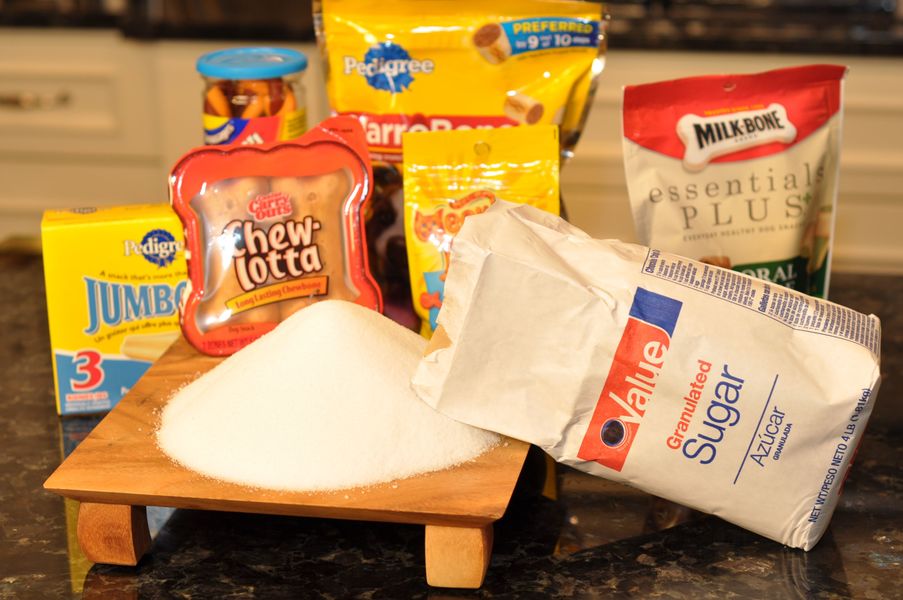
DSC_2800If you were making your own dog treats, using the freshest and most wholesome, healthy ingredients, would you ever consider dumping sugar into the mix?

Of course not. So why, then, do a number of the most popular dog treats on the market contain high amounts of sugar? Because dogs love it.

According to a press release from Dr. Ernie Ward, founder of the Association for Pet Obesity Prevention (APOP) and author of “Chow Hounds: Why Our Dogs Are Getting Fatter – A Vet’s Plan to Save Their Lives” (2010 HCI),
…the problem is linked to money – lots of it. With US pet treat sales estimated to be nearly $2 billion in 2010, the treat bowl has turned golden. “Sugar is incredibly attractive to dogs. If a dog gobbles a treat quickly, an owner is more likely to give another – and another.  This adds up to more sales – and profits. In the race for pet treat profits, our pets’ health is being bankrupted.”
With 45% of American dogs and 58% of cats considered overweight, an estimated 89 million pets are at high risk for developing conditions such as arthritis, diabetes, high blood pressure and more.
In addition to obesity, sugary treats lead to behavioral problems as well.
“Numerous studies in rats demonstrate that overfeeding sugar can create symptoms similar to drug addiction. A dog’s daily sweet treat may be contributing to overeating and other undesirable behaviors. This is why I call today’s high-sugar treats ‘kibble crack.’”
Still, pet treat manufacturers blame pet owners. They are, after all, the ones that purchase and feed the sugary treats.

So, Dr. Ward listed what he calls “The Dirty Dozen,” the 12 most popular sugary dog treats that should be avoided. Pet parents should be aware of what they’re feeding their pets, understand ingredient labels, and to avoid treats that masquerade as healthy and nutritious while silently contributing to the obesity epidemic.

His goal is to help pet parents to be more aware of what they’re feeding their pets. “Pet owners definitely have a feeding disorder when it comes to their pets. Ultimately it’s up to each owner to control how much they feed their pets. What I want to bring attention to is what ingredients are in pet treats – and why. Pet owners must begin to question why there is sugar in a treat that claims to help teeth,” he said.
Dr. Ward’s Dirty Dozen – Popular Sugary Pet Treats
Pet Treat Added Sugar
Canine CarryOuts Chew-lotta Dextrose first ingredient
Snausages SnawSomes! Beef and Chicken Flavor Sugars 3 of first 4 ingredients
Pedigree Jumbone Mini Snack Food for Small Dogs Sugars 2 of 3 first ingredient
Petrodex Dental Treats for Cats Dextrose second ingredient
Pedigree Jumbone Sugar third ingredient
Milk Bone Essentials Plus Oral Care Sugar third ingredient
Pup-Peroni Lean Beef Recipe Sugar third ingredient
Science Diet Simple Essentials Treats Training Adult Treats with Real Beef Sugar third ingredient
Cesar Softies Dog Treats Sugar third ingredient
Milk-Bone Chewy Chicken Drumsticks Sugar third ingredient
Meow Mix Moist Cat Treats Corn syrup fourth ingredient
Pedigree Marrobone Sugar third ingredient
Other common sugar-containing treats according to Dr. Ernie Ward:
  • Pedigree Jumbone – Sugar third ingredient
  • Beneful Snackin’ Slices – Sugar fourth ingredient
  • Pit’r Pat Fresh Breath Mint Flavored Cat Treats – Maltodextrin first ingredient
  • Three Dog Bakery Lick ‘n Crunch – Dextrose third ingredient
  • Beneful Snackin Slices – Sugar fourth ingredient
  • Busy Chewnola – Maltodextrin second ingredient
  • Exclusively Dog Vanilla Flavor Sandwich Creme Dog Cookies – Sugars first two ingredients
  • Canine Carryouts Dog Treats – Corn syrup second ingredient
For more information, visit www.PetObesityPrevention.com or www.DrErnieWard.com .